
How TCG Portfolio calculates Pokémon card prices
Estimates from eBay and TCGplayer, matched to your exact card.
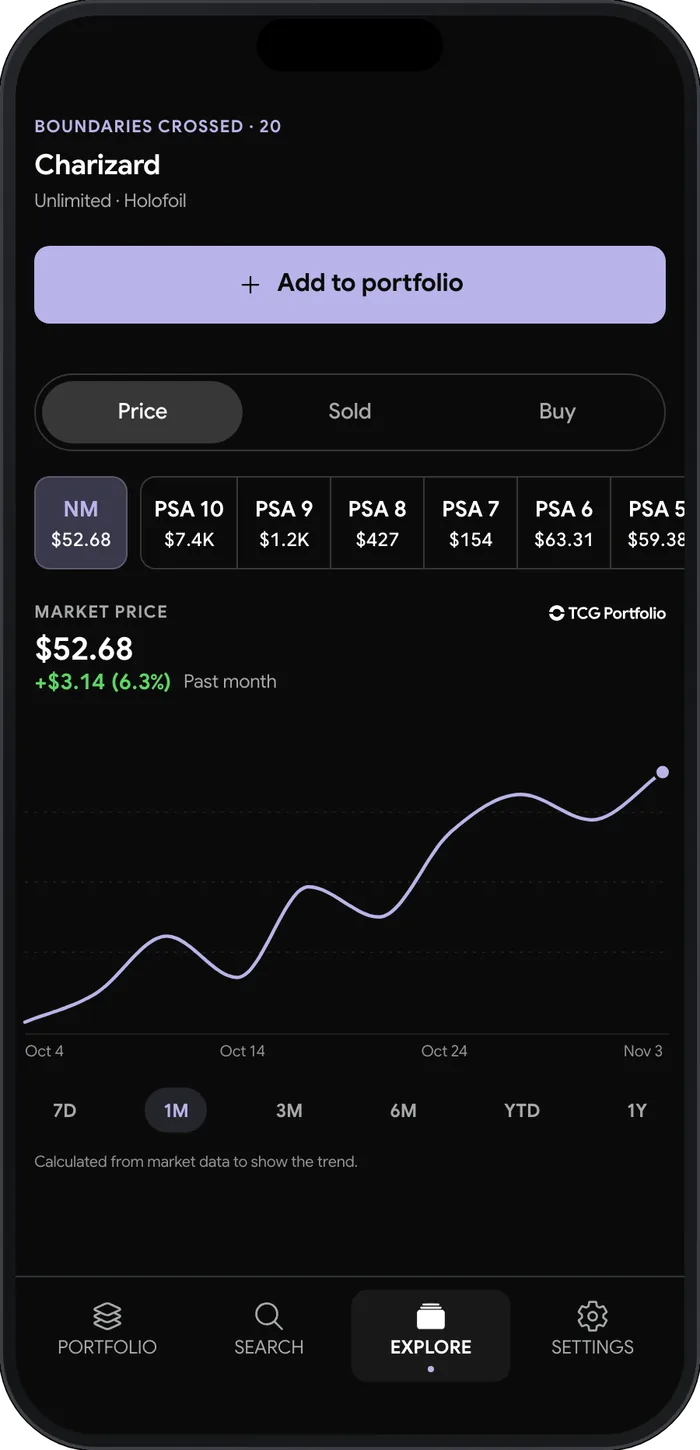
TCG Portfolio prices are estimates compiled from third-party sources, including eBay and TCGplayer, and tied to the exact printing, language and condition or PSA grade of each card you own. The app adds those estimates into one collection value and links to eBay sold listings so you can check any number yourself.
Where do TCG Portfolio prices come from?
Every price and valuation figure in TCG Portfolio is an estimate compiled from third-party sources, including eBay and TCGplayer. Prices are updated regularly, and new sets and pricing data are added frequently. eBay and TCGplayer are trademarks of their owners; TCG Portfolio is not affiliated with either of them.
How does TCG Portfolio match a price to your exact card?
The same Pokémon card can be worth very different amounts depending on how it was printed. TCG Portfolio tracks each printing separately, so a 1st Edition holo is never priced as a bulk reverse holo.
- Print run: Unlimited, 1st Edition or Shadowless.
- Finish: Normal, Holofoil, Reverse Holofoil or Anniversary Stamp. A printing is shown as print run plus finish, for example “1st Edition · Holofoil”.
- Language: English or Japanese. Japanese cards are priced in their own right, not converted from an English equivalent.
If a number looks off, check it against the eBay sold listings linked on the card page.
Why can two copies of the same card show different prices?
In TCG Portfolio, a price belongs to the details you record, not just to the card name. When you add a card, you add it either as an ungraded copy with its condition or as a PSA graded slab, along with its print run and finish. Two copies of the same Charizard can therefore carry very different estimates: one logged as a Lightly Played Unlimited holo, the other as a PSA 9 1st Edition holo. Record the condition or grade of the copy you actually own, so its estimate matches it.
How do condition and PSA grade change a TCG Portfolio price?
TCG Portfolio prices every card in one of two condition categories: Ungraded or PSA graded.
- Ungraded: Near Mint (NM), Lightly Played (LP), Moderately Played (MP), Heavily Played (HP) or Damaged (DMG). New copies default to Near Mint.
- PSA graded: PSA 1 (PR) through PSA 10 (GEM-MT), each with its own price. New slabs default to PSA 10.
Comparing grades side by side shows what a PSA 10 fetches against a PSA 9 or 8, and against an ungraded copy, before you buy a slab or submit an ungraded card. PSA is the only grading company the app prices today.
How does TCG Portfolio value your whole collection?
TCG Portfolio estimates a value for the cards you own, ungraded or graded, where price data is available, and adds the estimates up into a total collection value. Price charts for your portfolio and for each card cover 7D, 1M, 3M, 6M, YTD and 1Y. Values show in US dollars by default, and you can choose a different currency in Settings.
You can search cards and check prices without an account. Tracking a portfolio needs a free account, which keeps your collection on any device you sign in on.
How do you read a card’s price chart in TCG Portfolio?
The Price tab on each TCG Portfolio card page opens on a market price chart. Above it, a row of tiles lists the estimate for an ungraded copy and for each PSA grade from 10 down to 1. Tap a tile to chart that condition or grade.
The chart heading shows the current estimate and how much it has moved over the selected period, in dollars and as a percentage. Switch the period between 7D, 1M, 3M, 6M, YTD and 1Y to see short swings or the longer trend. The line is calculated from market data to show the direction of the price, not to list individual sales.
How often are TCG Portfolio prices updated?
TCG Portfolio prices are updated regularly, and new sets and pricing data are added frequently. Updates are not real time, so a sudden jump or drop in the market can take a while to show in an estimate, and some cards may have no price yet. For a card that is moving fast, the most recent eBay sold listings are the better guide to what copies are selling for today.
How can you check a TCG Portfolio price yourself?
Each card page in TCG Portfolio has Price, Sold and Buy tabs. The Sold tab links out to eBay sold listings for that card, including its language, and the card page also links to current eBay listings, so you can compare the estimate with recent sales yourself.
The sold-listings link opens an eBay search filtered to sold and completed listings, so you see prices that copies actually sold for rather than asking prices. Sold listings on the card page are free for everyone.
What are the limits of TCG Portfolio prices?
- All figures are estimates and may be inaccurate, delayed, incomplete or unavailable.
- Estimated values are not appraisals, offers or guarantees of what any card can be bought or sold for.
- TCG Portfolio is a personal collection and price-tracking tool, not a financial product. Nothing in it is investment, financial, tax or legal advice, or a recommendation to buy, sell or hold any card. Trading cards are collectibles, not regulated financial instruments.
The full wording is in the Terms of Service.
Get TCG Portfolio
Free on iOS and Android. Look up a card, pick its printing and condition, and see its estimated price.